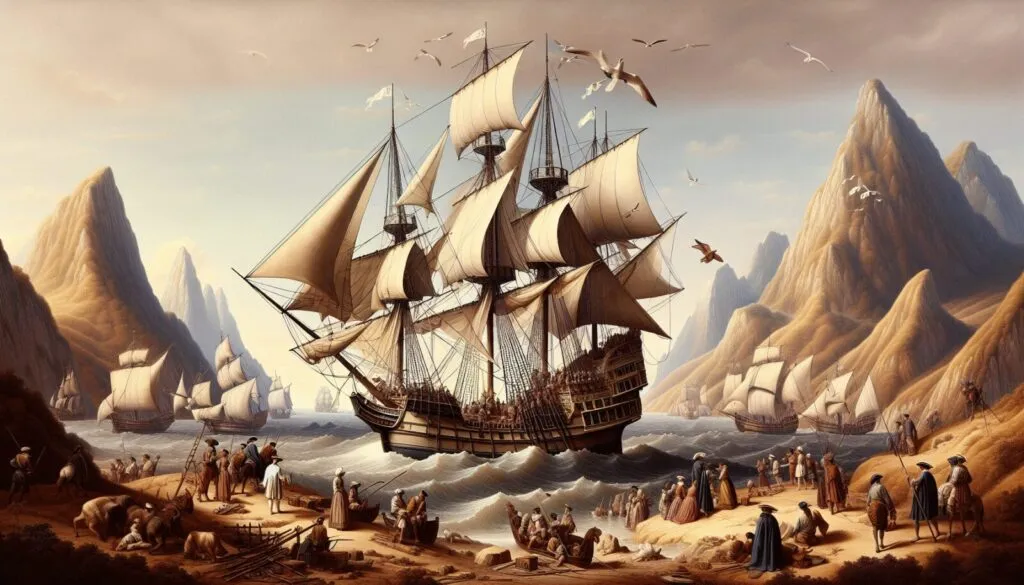
Vasco da Gama is a name that resonates through the annals of history, synonymous with exploration and adventure. His epic journey to India in 1497 was not merely an expedition; it represented a significant turning point in global trade and cultural exchanges. But what obstacles did this courageous navigator encounter during his groundbreaking voyage? Let’s delve into the myriad challenges he faced.
The Initial Challenges of Vasco da Gama’s Voyage
Setting sail from Lisbon with a crew of 170 men aboard three tiny ships, Da Gama was well aware of the risks that lay ahead. The vessels, known as the São Gabriel, São Rafael, and a supply ship named Berrio, were small compared to modern standards, ill-equipped for the unpredictable nature of the vast ocean.
Right from the start, the crew had to contend with:
- Unpredictable weather patterns that could change in an instant.
- Coastal reefs and uncharted waters that posed significant navigational hazards.
- A lack of proper maps, relying instead on traditional navigation methods and celestial bodies.
The sense of adventure was juxtaposed with the reality of facing the unknown, where every wave could potentially lead to disaster.
Psychological Strain on the Crew
As the days turned into weeks without significant land sightings, a heavy psychological toll began to take hold on Da Gama and his crew. The isolation of the open sea and the harsh conditions compounded their fears and anxieties.
Among the most pressing concerns were:
- **Fear of failure**: The crew was aware of the stakes involved; failure meant not just a return to Portugal empty-handed, but potential disgrace.
- **Morale issues**: Sustaining morale was vital, especially as supplies dwindled and hope seemed to fade.
- **Leadership pressures**: Da Gama had to maintain composure, acting as a stabilizing force amidst growing tensions.
The psychological stresses were as daunting as the physical challenges they faced on the voyage.
Geographical and Environmental Hazards
Upon rounding the treacherous Cape of Good Hope, the expedition encountered some of the most dangerous waters known to sailors of that era. The fierce winds and turbulent seas tested their ships and their resolve.
During this leg of the journey, Da Gama’s crew contended with:
- **Strong currents** that threatened to push them off course.
- **Storms** that could arise abruptly, causing damage to their ships.
- **Navigational difficulties** due to a lack of reliable instruments.
These environmental factors made the journey exceedingly perilous, laying bare the vulnerability of even the most prepared explorers.
Cultural Conflicts and Hostility
Reaching the African coast, the expedition faced yet another layer of complexity—cultural misunderstandings. When Da Gama and his crew arrived in Mozambique, their attempts to interact with local inhabitants were met with suspicion.
Key issues included:
- **Mistrust** from local communities towards these foreign sailors, who were perceived as potential threats.
- **Skirmishes** that erupted due to miscommunications, leading to violence rather than trade.
- **Political dynamics** in coastal regions that complicated their mission to establish trade routes.
These encounters made it clear that exploration was not just about navigating waters but also about understanding and engaging with diverse cultures.
Obstacles on the Way to India
As Da Gama’s fleet continued its journey towards India, they faced even greater challenges. The Indian subcontinent was a tapestry of cultures, each with its own political and social complexities.
Some of the obstacles included:
- **Hostile territories** guarded by powerful sultans who were not inclined to share their wealth.
- **Political intrigue** that could turn allies into adversaries overnight.
- **Logistical issues** related to resupplying their fleet in foreign ports.
Each port brought unique challenges, and Da Gama had to navigate these with diplomacy and caution.
Resilience and Adaptation
Despite the myriad difficulties, Vasco da Gama displayed remarkable resilience. Each setback became a lesson in adaptability, forcing him to reevaluate strategies and approaches. He learned to:
- **Forge alliances** where possible, building relationships with influential local leaders.
- **Remain vigilant** against betrayal, understanding that trust was a scarce commodity.
- **Adjust his expectations**, realizing that the voyage was as much about cultural exchange as it was about trade.
This adaptability was crucial in transforming challenges into opportunities, enabling the expedition to weather the storms—both literal and metaphorical.
Legacy and Impact of the Voyage
Ultimately, Vasco da Gama reached Calicut, a bustling hub of trade and spices. This achievement was monumental, not just for him but for the entire Age of Exploration. His voyage opened new trade routes, establishing direct links between Europe and Asia.
The impact of his journey can be summarized as follows:
- **Expansion of trade networks**, significantly increasing the flow of spices and other goods to Europe.
- **Cultural exchanges** that would shape future interactions between East and West.
- **Foundation for colonial ambitions**, paving the way for European powers to establish dominance in Asia.
Vasco da Gama’s legacy is not merely one of exploration; it is a testament to human resilience in the face of overwhelming odds.
Interesting Facts About Vasco da Gama
To further appreciate the life and contributions of Vasco da Gama, here are some intriguing facts:
- He was born around 1460 in Sines, Portugal.
- His first voyage to India took nearly two years to complete.
- He was appointed as the Portuguese viceroy in India later in his life.
- His journeys were inspired by a desire to establish a sea route to the spice-rich lands of Asia.
These facts reveal the remarkable life of a man who changed the course of global history.