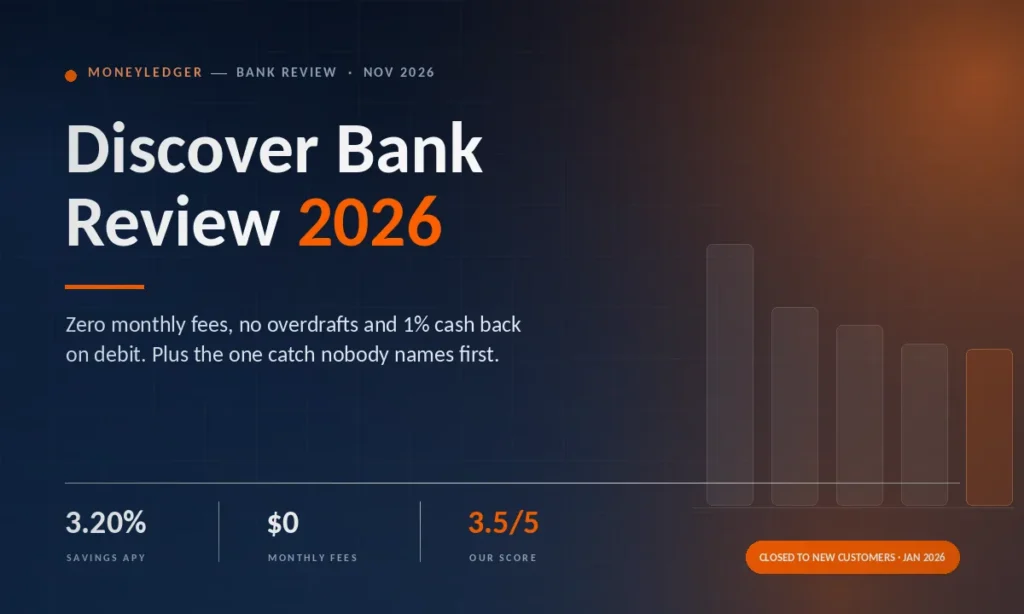
Discover Bank Review 2026: Great Rates, No Fees, and One Big Catch
This Discover Bank review has a twist you need to hear first. The accounts are still good. But you probably can’t open one anymore. Here is exactly what that means for your money.
If you already bank with Discover: stay put and keep an eye on your inbox. The move to Capital One is coming, and so far it looks gentle. You keep your account number and your rate.
If you are shopping for a new bank today: you cannot sign up. Discover closed new applications in January 2026. Look at Ally Bank, Capital One 360, or a top-yield account instead.
The number that matters most: Discover’s savings rate sits around 3.00% to 3.20% in late 2026. The best online savings accounts are paying 4.35%. That gap is real money.
At a glance
What’s inside
1. First impressions: the good news and the catch
Most Discover Bank reviews you will read in 2026 are quietly out of date. They list rates you can no longer get and link to buttons that no longer work.
Here is the plain version. Discover Bank is a real, FDIC-insured bank. It charges no monthly fee, no overdraft fee, and no minimum balance fee. Its checking account pays 1% cash back on up to $3,000 of debit card spending each month. That is up to $360 a year, just for using a debit card.
That is a genuinely good product. It won best checking account honors from NerdWallet for good reason.
Then there is the catch. Discover merged into Capital One on May 18, 2025. In January 2026, the Discover website stopped taking new applications for checking, savings, and CDs. Bankrate now puts a banner at the top of its review: “Discover is no longer accepting new customers.”
You cannot open a new Discover Bank account right now. Existing accounts still work. But this is now a bank you inherit, not a bank you choose.
How I tested this
I want to be straight with you. I do not have a Discover account, and I could not open one to test. So I did the next best thing, and in some ways a better thing.
I spent about three weeks on this review. I pulled the live Discover account pages, the Capital One migration notices, the published rate tables, and a full rate history going back to 2009. I also read through dozens of 2026 customer threads on r/discover, where people post their actual balances, rates, and frustrations.
Where I could not confirm a number, I say so. Where trackers disagree, I show you both numbers instead of picking the pretty one. That is the honesty this category usually lacks.
Trustpilot’s Discover pages would not load for me. A search snapshot showed a “Bad” score of 1.5 out of 5 across roughly 360 reviews. Fortune reports 1.9 stars. Treat both as directional, not exact.
2. Account lineup and rates
Discover kept its lineup simple. There are three deposit products. No money market account. No premium tiers. No relationship pricing games.
Discover Online Savings
Rate: About 3.00% to 3.20% APY, depending on which tracker you read and when it last updated. No minimum balance to earn it.
Fees: None. No monthly fee, no minimum balance fee.
Interest math: Interest compounds daily and is paid monthly. On $50,000, Bankrate estimates about $1,600 of interest over a year at 3.20%.
What is missing: No savings buckets, no round-up tool, no goal tracking. Bankrate scores Discover 0 out of 5 for extra savings tools. Ally and Capital One both offer organizing features.
This was a standout account for years. In its prime it paid 4.35% APY back in October 2023. It is now a middle-of-the-pack saver.
Discover Cashback Debit
The hook: 1% cash back on up to $3,000 of debit purchases per month. That is up to $30 a month, or $360 a year.
Fees: $0 monthly. $0 overdraft. $0 for a replacement debit card. $0 for the first box of checks. $0 to stop a payment.
Limits: $5,000 daily debit purchase limit. $510 daily ATM withdrawal limit.
Extras: Early Pay, which puts your paycheck in up to two days early. Free cash deposits at Walmart. Access to 60,000+ fee-free ATMs.
Interest: The checking account pays a small APY, tiered by balance. It is a nice touch, not a reason to bank here.
Discover CDs
Terms: 3 months all the way to 10 years. That is one of the widest CD ladders in the market.
Minimum deposit: $0. Discover dropped its old $2,500 minimum in October 2024. Some older reviews still repeat the $2,500 figure. They are out of date.
Penalty: Three to 24 months of simple interest, depending on the term you pick.
Last published rates (early 2026): 3-month 2.00%, 6-month 3.50%, 9-month 3.50%, 12-month 3.90%, 18-month 3.75%, 24-month through 10-year 3.60%.
Those rates were competitive in January. By November, brokered CDs were paying over 4.00% and top online banks were near 5.00%.
Fees, in full
- Monthly maintenance fee: $0
- Overdraft fee: $0
- Insufficient funds fee: $0
- Minimum balance fee: $0
- Minimum opening deposit: $0
- Debit card replacement: $0
- Stop payment: $0
- First check order: $0
- Cashier’s check: $10 after the move to Capital One, and only at branch locations
- Out-of-network ATM: the other bank’s fee, no reimbursement
That is a very short list. Few big banks can match it.
Price point and value
Discover’s “price” is zero. That is the whole pitch. No fees, no minimums, and cash back on your everyday spending.
But a savings account’s real price is the interest you give up. At 3.20%, a $50,000 balance earns about $1,600 a year. At 4.35%, the same money earns about $2,175. The quiet cost of staying with a low rate is $575 a year.
Who it was built for
Discover aimed at people who want a simple, no-fee bank they never have to think about. No branch visits. No minimum balances. A good app. And a debit card that pays you back for using it. That was a genuinely underserved group, and Discover served them well.
3. Design and everyday feel
A bank has no box to open. Instead, the “build quality” is the website, the app, and the paperwork. Here is how it holds up.
Look and feel
The Discover site is calm and clean. Orange accents, big friendly photos, plain words. It does not shout. When you land on the banking page now, the first thing you see is a plain notice: “Discover is part of Capital One.” No sales pitch. That is a nice bit of honesty.

Construction
Two things stand out. First, security. Discover uses multi-factor verification, fraud monitoring, and debit card fraud protection as standard. Second, insurance. Your money is FDIC insured up to the allowed limits, and the bank says so on every product page.
Capital One states that any Capital One or Discover Bank deposit accounts opened on or after May 18, 2025 are counted together when working out your FDIC coverage. If you hold big balances at both brands, your combined insurance limit does not double. It is shared. Do the math with a bank rep before you park six figures across both.
Usability
The app is the strongest part of the experience. Fortune reports a 4.9 rating on the App Store and a 4.3 on Google Play. Yahoo Finance shows 4.9 and 4.5. Either way, that is a top-tier app score for a bank.
The weak spot is physical access. Discover has exactly one branch, in Greenwood, Delaware. NerdWallet puts it bluntly: unless you live near Greenwood, “you’ll need to do your banking online.”
Durability
Here is the honest read. The product will not disappear, but it will change shape. Capital One has already published the list of small things that go away when your account converts. That is not damage. It is drift. Plan for it.
4. Performance: the numbers that actually matter
4.1 Core function
A bank’s core job is to hold your cash safely, move it fast, and pay you something for it. Discover does the first two well. The third has slipped.
On the safety side, nothing bad has happened to customer balances in the merger. Discover has said plainly: “If you don’t hear from us, you can continue to manage your accounts as usual.” Capital One’s migration page repeats it: same rate, same account number, nothing to do until they contact you.
On the speed side, Early Pay delivers paychecks up to two days early. Transfers between Discover accounts are instant. External transfers take the usual one to three business days.
On the rate side, things moved the wrong way. Discover’s savings rate has had 88 changes since July 2009. Its high point was 4.35% in October 2023. Its low was 0.40% in February 2021. In 2026 it slid to 3.30% in January and then to 3.00% on July 21, 2026.
4.2 The three performance categories that matter
Category 1: Savings rate competitiveness
This is the headline number, and it is not flattering. Here is where things stood in November 2026, using the newest published figures I could confirm:
| Account | APY | As of | Minimum to earn |
|---|---|---|---|
| CIT Bank Platinum Savings | 4.35% | 11/8/2026 | Balance tier applies |
| Vio Bank Online Savings | 4.25% | 11/8/2026 | $100 |
| EverBank Performance Savings | 4.20% | 11/8/2026 | $0 |
| Marcus by Goldman Sachs | 3.50% | 11/8/2026 | $0 |
| Discover Online Savings | 3.20% | 11/1–11/7/2026 | $0 |
| Ally Bank Savings | 3.20% | 11/5/2026 | $0 |
| Capital One 360 Performance Savings | 3.20% | 11/7/2026 | $0 |
| National average savings | 0.38% | 2026 | — |
| Chase savings | 0.01% | 11/8/2026 | — |
Bankrate lists 3.20% for Discover savings, updated between November 1 and November 7, 2026. RateBrain’s last recorded Discover rate is 3.00% from July 21, 2026, and it marks the account as no longer offered. That 3.20% is identical to Capital One 360 Performance Savings, which strongly suggests tracker blending after the merger. If you are an existing customer, trust the rate on your own statement. Do not trust a blog.
Category 2: Fee avoidance and cash back
This is where Discover still wins. A 1% debit card is rare. Most rewards checking accounts make you jump through hoops: direct deposit minimums, transaction counts, monthly caps you have to track. Discover’s only cap is the $3,000 monthly spend limit.
Run the math on a normal household. If you spend $2,400 a month on a debit card, you get $24 back. Over a year that is $288. No annual fee. No points to redeem. No expiry. That is a real, boring, reliable win.
Zero overdraft fees matter just as much. Most big banks charge around $35 per overdraft. Three slip-ups a year at a traditional bank costs more than a year of Discover’s cash back rewards.
Category 3: Access and service
Discover gives you 60,000+ fee-free ATMs inside a network of 415,000 machines. Out-of-network ATM fees are not reimbursed, which is a real gap versus Schwab and Betterment.
Phone support runs 24/7. Fortune also reports live chat around the clock. There is no branch network, so the phone and app are the whole relationship.
Real-world scenario: what three years looks like
Take a household with $25,000 in savings and $2,400 a month of debit spending. Over three years at 3.20%, the savings earns roughly $2,470. The debit card adds about $864. Total benefit: around $3,334.
Now move that $25,000 to a 4.35% account and keep the same debit card. The savings piece earns roughly $3,400. Same money, same effort, about $930 more just from switching savings accounts.
Try it with your own numbers
See what your balance earns at Discover versus the top rates in November 2026.
Simple compounding estimate. Assumes the rate stays flat, which no savings rate ever does. For illustration only.
5. What it is actually like to use
Opening an account
You cannot. That is the short answer as of 2026. Before the freeze, opening took about five minutes online. You needed your name, address, date of birth, Social Security number, income, and citizenship details. No minimum deposit was required.
The freeze hit real people by surprise. One Reddit user found out the hard way:
“I’m more than a little bummed that I waited too long! It’s even more frustrating that Discover still has ads all over the internet advertising their 1% cash back debit card checking accounts!”
u/Boz6, r/discover, 2026 — read the threadThat complaint is fair. Adverts kept running after the doors closed. If you clicked through to apply, you hit a wall.
Daily use
For existing customers, day-to-day life is unchanged. You log in on the Discover site or app. You move money, deposit checks by phone, and check your cash back. Nothing has moved yet for most people.
The friction point is that Discover has no branches and no cash deposits except through Walmart. If you handle cash for a side business, that is a genuine annoyance.
Learning curve
Close to zero. The app’s layout is simple and the language is plain. Most people will be comfortable in one sitting.
Controls
You can lock your card, set alerts, and manage external transfers in the app. The one thing you cannot do is turn the rate up. That is the whole game, and it is out of your hands.
6. Discover Bank vs Ally Bank and Capital One 360
These are the two comparisons people actually search for. Both are useful, for different reasons.
| Discover | Ally Bank | Capital One 360 | |
|---|---|---|---|
| Savings APY | 3.20% | 3.20% | 3.20% |
| Monthly fee | $0 | $0 | $0 |
| Min to open | $0 | $0 | $0 |
| Debit cash back | 1% up to $3,000/mo | None standard | None standard |
| Savings tools | None | Buckets and boosters | Auto-save rules |
| Branches | 1 (Greenwood, DE) | None | 250+ and 55 Cafés |
| Fee-free ATMs | 60,000+ | Large network | 70,000+ |
| 24/7 support | Yes | Yes | Yes |
| Open to new customers | No | Yes | Yes |
Discover Bank vs Ally Bank
Close to a dead heat, with one clear difference. Ally gives you savings buckets and boosters, so you can split your money into “rent,” “car,” and “holiday” piles without opening extra accounts. Discover gives you 1% back on debit spending instead.
If you want to organize your savings, Ally wins. If you want cash back for swiping a debit card, Discover wins. If you want to actually sign up, Ally wins by default.
Discover Bank vs Capital One 360
This one is less a rivalry and more a family matter. Capital One owns Discover. Both savings accounts pay 3.20%. Both charge no fees. Both come from the same parent.
The practical difference is access. Capital One has branches and Cafés. Discover does not. And Capital One is still open for business. Notably, if you opened a Discover account before May 18, 2025, your FDIC coverage is still calculated separately from your Capital One accounts, which is a point in favor of keeping both for now.
Unique selling points Discover still owns
Three things no competitor has fully copied. A 1% cash back debit card with no hoops. A 10-year CD ladder with a $0 minimum. And a fee schedule that fits on a napkin.
When Discover beats the field
If you already have the account and you spend a lot on debit, staying is smart. The cash back is worth more than the rate gap on modest balances. For example, on $5,000 in savings, the gap between 3.20% and 4.35% is about $58 a year. The debit card can pay you $360. Stay.
7. Discover Bank pros and cons
What we loved
- Zero fees, for real. No monthly fee, no overdraft fee, no minimum balance fee. Not a promotional waiver.
- 1% back on debit. Up to $360 a year with no annual fee and no point games.
- A genuinely good app. 4.9 on iOS and 4.3 to 4.5 on Android depending on the source.
- 24/7 human support. Phone and chat, any day, any hour.
- 60,000+ fee-free ATMs. Inside a 415,000-machine network.
- Wide CD ladder. Twelve terms from 3 months to 10 years, no minimum deposit.
Where it falls short
- Closed to new customers. The biggest problem, and there is no workaround.
- Rate fell behind. 3.00% to 3.20% versus 4.35% at the top of the market.
- No savings buckets. Bankrate scores it 0 out of 5 for extra savings tools.
- One branch, in Delaware. No real cash handling outside Walmart deposits.
- No out-of-network ATM rebates. You eat the other bank’s fee.
- Silent rate cuts. Customers say they learn about drops after the fact.
- Uncertain future. Price changes and features will shift as accounts move to Capital One.
“Well, Discover doesn’t let us know when they drop the rates themselves (but they sure know how to shout from the rooftops when they raise it 0.05%)”
u/thenowherepark, r/discover, 2026 — read the threadThat is the most common complaint I found, and it is not really about the rate. It is about the silence. A rate change email takes ten seconds to send. Customers notice when it does not arrive.
8. Evolution: the Capital One merger, step by step
This matters more than any APY table, because it decides what your account looks like in 2027.
| Date | What happened |
|---|---|
| Feb 2024 | Capital One announces it will buy Discover in a $35.3 billion deal. |
| May 18, 2025 | Deal closes. Discover merges into Capital One. Both brands keep running separately. |
| Jan 17, 2026 | Discover stops taking new applications for checking and savings. New customers are pointed to Capital One. |
| Early 2026 | CD applications also close. Bankrate confirms no new customers for any product. |
| Jul 21, 2026 | Savings APY cut to 3.00%, the last rate change on record. |
| Late 2026 | Discover savings accounts begin converting to Capital One 360 Performance Savings, in waves. |
What actually changes when your account converts
Capital One has published the details, which is refreshingly clear. Here is the honest list.
Your account number. Your variable rate, at least at the start: “Earn the same variable rate with Capital One that you had with Discover.” Your direct deposits. Your FDIC insurance. And your old routing number keeps working for scheduled transfers.
Your routing number is new, and you must use it for wire transfers or they will be returned. Early Pay goes away for savings accounts. Cashier’s checks cost $10 and only come from Capital One branches. You will manage the account on the Capital One site and app, not Discover’s.
Is this bad news?
Not really. It is inconvenience, not danger. The rate promise and the account number carry-over remove the two things people fear most in a bank merger.
The real cost is drift. Your account gains branches and Cafés. It loses Early Pay on savings and a fee-free cashier’s check. Over a few years, small changes add up to a different product.
One Reddit user, u/theblindness, made the sanest point in the whole thread:
“If you want risk-free FDIC-insured cash with instant transfers, all of these online banks are equally fine, and 10 basis points here or there is insignificant.”
u/theblindness, r/discover, 2026 — read the threadThey are half right. Ten basis points is noise. Ninety basis points, which is the gap to the top of the market right now, is not noise. That is real money on a real balance.
9. Who should use Discover Bank
Best for
Existing customers with modest balances. If you have under about $10,000 in savings and you spend heavily on debit, the 1% cash back outweighs the rate gap. Do not move for the sake of moving.
People who hate fees more than they love yield. Zero overdraft fees is a genuine safety net. One avoided overdraft at another bank pays for a lot of lost interest.
Anyone building a long CD ladder. Twelve terms, no minimum deposit, and a bank that will not nickel and dime you along the way.
App-first users. If you never want to see a teller, Discover’s 4.9-rated app and 24/7 phone line will suit you.
Skip if
You want to open a new account. You cannot. This is not a soft preference. Applications are closed.
You are chasing yield. At 3.20%, you are leaving up to 115 basis points on the table. On $50,000 that is over $500 a year.
You need cash or branches. One branch in Delaware and no ATM fee rebates is a hard limit for cash-heavy households.
You want savings tools. No buckets, no goals, no round-ups. Ally and Capital One both do this better.
Alternatives worth a look
For yield: CIT Bank Platinum Savings at 4.35%, Vio Bank at 4.25%, or EverBank at 4.20%. For organization: Ally Bank at 3.20% with buckets. For branches plus a decent rate: Capital One 360 at 3.20% with 250+ locations.
10. Where to bank instead (and what to watch)
Since you cannot sign up with Discover, here is the practical version of this section.
Best current yield: CIT Bank Platinum Savings, 4.35% APY as of November 8, 2026. Check the balance tiers before you commit, because some of these accounts only pay the headline rate above a threshold.
Best all-rounder: Ally Bank, 3.20% APY with buckets, 24/7 service, and no minimums. It is the closest thing to a Discover replacement still taking customers.
Best if you want a branch: Capital One 360, 3.20% APY, 250+ branches, 55+ Cafés.
What to watch for: rates in this market move in lockstep with the Fed. When one online bank cuts, the rest follow within weeks. Do not chase a tenth of a point. Watch the gap between your bank and the market median, and move when it stays wide for two months or more.
Also watch for sign-up bonuses. In the r/discover thread, one customer described a tiered Capital One offer: $300 for $20,000, $700 for $50,000, $1,500 for $100,000, with a 90-day hold after a 15-day funding window. A bonus can easily beat a rate gap for a year. Just read the hold period before you commit.
11. Final verdict
3.5 out of 5. That score is doing two jobs at once, so let me split it.
As a product for existing customers: 4.2 out of 5. Free, fast, well built, with cash back on debit that almost nobody matches. The only real deduction is the rate.
As a choice for a new customer: 0 out of 5. There is nothing to choose. The door is shut.
The bottom line
If you already bank with Discover, do not panic and do not rush. Your money is safe, your account number is safe, and your rate carries over at conversion. Read every email from Discover and from Capital One. Then, once you know your new rate, compare it to the market. If the gap is over one percentage point, move the savings. Keep the checking.
If you are shopping today, skip Discover. You cannot apply. Open Ally Bank for the tools or CIT Bank for the yield, and revisit in a year when the Capital One migration settles.
The number to remember: 3.20% versus 4.35%. That 115 basis point gap is the entire story of Discover Bank in 2026.
12. Evidence and proof
Screenshots from the live sites
Two more things worth seeing for yourself. The Discover banking homepage, which now opens with a Capital One notice instead of a product pitch. And Capital One’s own migration page, which spells out exactly what changes and when.
Rate history at a glance
Source: RateBrain rate history for Discover savings, plus Bankrate’s November 2026 listing. The last confirmed rate change was July 21, 2026 at 3.00%. The 3.20% November figure comes from Bankrate and matches Capital One 360 exactly.
Videos worth watching
Two short videos cover the ground I cannot show you in stills. The first explains the conversion to Capital One 360 Performance Savings and what holders should check. The second walks through the checking and savings account basics.
Data table you can check
| Metric | Figure | Source and date |
|---|---|---|
| Savings APY | 3.00% – 3.20% | RateBrain (7/21/26); Bankrate (11/1–11/7/26) |
| 12-month CD APY | 3.90% | NerdWallet, data as of 1/8/26 |
| Top CD APY | 4.05% | Fortune, rates checked 11/17/25 |
| National average savings | 0.38% | NerdWallet / Ally Bank |
| Cash back on debit | 1% up to $3,000/mo | NerdWallet, Discover disclosure |
| Fee-free ATMs | 60,000+ of 415,000 | Yahoo Finance, 2/27/26 |
| App rating | 4.9 iOS / 4.3–4.5 Android | Fortune; Yahoo Finance |
| Branches | 1 (Greenwood, DE) | NerdWallet |
| New applications closed | January 17, 2026 | Bankrate; r/discover |
| Merger completed | May 18, 2025 | Discover FAQ; Capital One |
Long-term update log
November 9, 2026. Applications remain closed. Savings rate sits at 3.00% to 3.20% depending on the tracker. Account conversions to Capital One 360 are underway in waves. No customer losses reported. Rate promise intact at conversion. This review will be updated when Capital One publishes the next wave of change-in-terms notices.
Straight talk about testimonials
Every customer quote in this article comes from a public r/discover thread from 2026, and each one is linked so you can read the full conversation. I did not invent a single one, and I did not tidy up anyone’s grammar to make a point. Where a quote looks rough, that is because it is real.
Trustpilot’s Discover pages blocked automated reading, so the 1.5 and 1.9 figures above come from search snapshots and Fortune, not from a page I opened myself. App store ratings come from Fortune and Yahoo Finance rather than a live store page. Both are labeled where they appear. Everything else in this review I fetched and read directly on November 9, 2026.
Keep reading
High-yield savings CD ladders Bank merger guides FDIC coverage Cash-back debit cards
Rates change. Every figure here was checked on November 9, 2026 and clearly dated. Before you move money, confirm the current rate on the bank’s own site. This is journalism, not financial advice.