kgr checker
Online KGR Checker
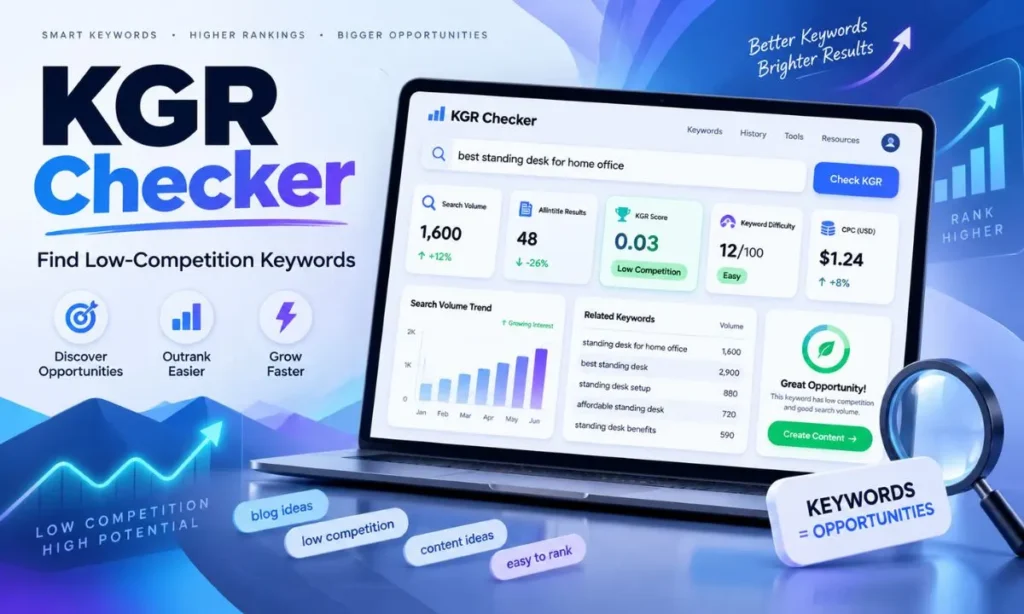
Find low-competition keywords using the Keyword Golden Ratio. Check search volume, allintitle results, keyword difficulty, CPC, search intent and related keyword opportunities.
—
—
—
How to read this result
Bulk KGR Checker
Enter one keyword per line. Automatic bulk checks use your API endpoint and intentionally skip related-keyword calls to reduce API cost.
| Keyword | Volume | Allintitle | KGR | KD | CPC | Intent | Verdict |
|---|
Recent Checks
| Keyword | Volume | Allintitle | KGR | KD | Verdict |
|---|
How the Keyword Golden Ratio works
KGR = number of Google allintitle results ÷ monthly search volume. The classic KGR method is primarily used for long-tail keywords with fewer than 250 monthly searches.
KGR ≤ 0.25
Strong KGR opportunity, especially when monthly search volume is 250 or lower.
0.25 < KGR ≤ 1.00
Possible opportunity, but review the SERP and site authority before targeting it.
KGR > 1.00
Usually more competitive according to the KGR methodology.
KGR is a heuristic, not a ranking guarantee. Always review search intent, SERP quality, topical authority and content usefulness before publishing.
What Is a KGR Checker?
A KGR Checker is a keyword research tool that calculates the Keyword Golden Ratio, a simple metric designed to identify search terms with relatively low title-level competition compared with their monthly search demand.
The basic formula is:
KGR = Allintitle Results ÷ Monthly Search Volume
For example, imagine a keyword receives 100 searches per month and Google returns 15 pages when checking that phrase with the allintitle: search operator.
The calculation would be:
15 ÷ 100 = 0.15 KGR
A KGR of 0.15 falls inside the commonly used low-competition range.
But keyword research should not stop there.
Our KGR Checker goes beyond a basic calculator by helping you analyze several signals together, including:
- Monthly search volume
- Allintitle competition
- Keyword Golden Ratio
- Keyword Difficulty
- Cost per click
- Search intent
- Related keywords
- SEO Opportunity Score
This gives you more context before deciding whether a keyword deserves a new article, landing page, product page, comparison, review, or other piece of search-focused content.
How Does the KGR Checker Work?
The Keyword Golden Ratio compares two different pieces of SEO data.
The first is search demand.
This is represented by estimated monthly search volume.
The second is title competition.
This is measured by checking how many indexed pages deliberately use the keyword terms in their page titles.
The relationship between those two numbers produces the KGR.
Consider these examples:
| Keyword Example | Search Volume | Allintitle | KGR | Initial Signal |
|---|---|---|---|---|
| Keyword A | 80 | 8 | 0.10 | Strong |
| Keyword B | 120 | 28 | 0.23 | Strong |
| Keyword C | 150 | 89 | 0.59 | Moderate |
| Keyword D | 100 | 170 | 1.70 | Competitive |
A lower ratio means fewer title-targeted pages exist relative to the estimated number of monthly searches.
That can reveal keyword opportunities that might be overlooked when using search volume alone.
How to Use Our Free KGR Checker

Using the tool is straightforward.
1. Enter your target keyword
Start with a specific search phrase.
Long-tail keywords generally make more sense for KGR analysis than extremely broad terms.
Instead of entering:
SEO tools
try something more specific such as:
best SEO tools for small local businesses
Specific searches usually reveal clearer search intent and make competition easier to evaluate.
2. Select your target country
Keyword data can change significantly by location.
A phrase searched in the United States may have completely different demand and competition in the United Kingdom, Canada, Spain, Mexico, or another market.
Always analyze the country where you actually want the page to rank.
3. Run the KGR analysis
Click Check KGR.
When automatic data is available, the tool can analyze the keyword and return the most important metrics in a single report.
You will see:
Search Volume
The estimated number of monthly searches.
Allintitle Results
The number of competing pages detected for the title-focused query.
KGR Score
The ratio between allintitle competition and search volume.
Keyword Difficulty
An additional estimate of organic ranking competition.
CPC
The estimated advertising cost per click, which can also provide clues about commercial value.
Search Intent
The likely reason behind the search.
Opportunity Score
An additional score designed to make several SEO signals easier to compare.
4. Review the recommendation
Do not make your decision based only on whether the KGR number appears green.
Check the complete keyword profile.
A keyword with:
- KGR of 0.15
- KD of 12
- clear informational intent
- 140 monthly searches
may be significantly more attractive for a newer informational site than another keyword with:
- KGR of 0.18
- KD of 75
- unclear search intent
- strong brands dominating the SERP
The KGR is therefore a filtering metric, not a replacement for SERP analysis.
What Is the Keyword Golden Ratio?
The Keyword Golden Ratio, usually abbreviated as KGR, is a keyword-research method based on the relationship between the number of pages intentionally targeting a phrase in their titles and the estimated monthly demand for that phrase.
Unlike a normal keyword search, which may count pages that mention your words anywhere in their content, KGR attempts to isolate stronger title-level competitors.
This makes it particularly useful when researching long-tail keywords.
The formula remains intentionally simple:
Allintitle Results / Monthly Search Volume = KGR
You do not need a complex SEO calculation to understand the result.
The difficult part is interpreting it correctly.
What Is a Good KGR Score?
A commonly used interpretation looks like this:
KGR of 0.25 or lower
This is generally considered the strongest KGR range.
There are relatively few title-targeted pages compared with the monthly search demand.
For example:
20 allintitle results ÷ 100 monthly searches = 0.20
This would produce a strong KGR signal.
KGR between 0.25 and 1.00
This is a moderate range.
The keyword may still be worth targeting, but you should investigate:
- ranking domains
- content quality
- backlink strength
- user intent
- topical relevance
- SERP features
before committing resources.
KGR greater than 1.00
This generally indicates higher title competition relative to search volume.
For example:
200 allintitle results ÷ 100 searches = 2.00
There are twice as many title-targeted results as estimated monthly searches.
For a new site, there may be better opportunities available.
Why Does the 250 Search Volume Rule Matter?
Traditional KGR research is most closely associated with relatively low-volume long-tail keywords.
A commonly used upper threshold is approximately 250 monthly searches.
That does not mean a keyword receiving 251 searches becomes bad.
It means the KGR should become more directional as volume increases.
Consider this keyword:
- Search Volume: 90
- Allintitle: 10
- KGR: 0.11
That fits the traditional KGR use case extremely well.
Now consider:
- Search Volume: 8,000
- Allintitle: 500
- KGR: 0.0625
Mathematically, the second keyword has an even lower ratio.
But ranking for an 8,000-search keyword could still be extremely difficult because KGR does not measure every competitive factor.
This is why our checker identifies high-volume cases separately rather than simply labeling every low ratio as an easy keyword.
What Does Allintitle Mean in SEO?
allintitle: is a Google search operator used to restrict a search toward pages containing specified terms in their titles.
A manual search might look like:
allintitle:"best budget coffee grinder for espresso"
The idea is to determine approximately how many pages have deliberately optimized their title around the phrase.
Title tags remain one of the clearest indicators of a page's primary topic.
Therefore, comparing title-targeted pages with search volume provides another way to measure competition.
However, allintitle should not be confused with total SEO difficulty.
A competitor can rank without using your exact phrase in its title.
Google can also rank:
- authoritative domains
- category pages
- product pages
- forums
- videos
- ecommerce listings
- closely related semantic results
even when their titles do not perfectly match the phrase.
That is why advanced keyword research requires more than one metric.
KGR vs Keyword Difficulty: What Is the Difference?
KGR and Keyword Difficulty attempt to answer related but different questions.
| Metric | What It Measures |
|---|---|
| KGR | Title-targeted competition relative to search demand |
| Keyword Difficulty | Estimated strength of competing organic results |
| Search Volume | Estimated monthly demand |
| CPC | Advertiser value |
| Search Intent | What the searcher wants to accomplish |
| SERP Analysis | Who currently ranks and why |
A keyword can have a low KGR but high Keyword Difficulty.
It can also have moderate KGR but surprisingly weak organic results.
For this reason, experienced SEO research works better when multiple signals point in the same direction.
Example of a strong opportunity
Suppose you discover:
Search Volume: 170
Allintitle: 21
KGR: 0.124
KD: 17
CPC: $1.85
Intent: Commercial
That keyword deserves attention.
You have measurable demand, limited title competition, relatively low estimated difficulty and signs of commercial value.
Example requiring caution
Now consider:
Search Volume: 210
Allintitle: 18
KGR: 0.086
KD: 74
CPC: $6.20
Intent: Commercial
The KGR looks excellent.
But the high KD and CPC suggest you should inspect the SERP carefully.
You could be competing against large commercial websites with powerful backlink profiles.
The KGR alone would not reveal that.
Understanding Search Intent Before Targeting a KGR Keyword
A low-competition keyword is useless if your page does not satisfy the user's intent.
Search intent can generally be divided into four groups.
Informational intent
The user wants an answer or explanation.
Examples:
- how does KGR work
- what is keyword golden ratio
- how to find easy keywords
The best result is usually educational content.
Commercial intent
The user is researching products, services, or tools before deciding.
Examples:
- best KGR checker
- best keyword research software
- KGR checker comparison
Reviews, comparisons and tool pages can perform well here.
Transactional intent
The searcher is close to performing an action.
Examples might include buying software, subscribing to a service or downloading something.
Navigational intent
The user is trying to reach a particular brand, website or product.
Your KGR Checker displays intent information because low competition without intent alignment is not enough.
If you want to go deeper into modern search visibility, our guide on getting a business recommended by ChatGPT and Google AI also explains why search intent and topical relevance matter beyond traditional keyword matching.
What Is the Opportunity Score?
The Opportunity Score in our KGR Checker is separate from the traditional Keyword Golden Ratio.
It should not be confused with the KGR formula.
KGR only calculates:
Allintitle ÷ Search Volume
The Opportunity Score adds additional context to make large keyword lists easier to prioritize.
It considers signals such as:
- KGR strength
- Keyword Difficulty
- Search-volume fit
A higher score means the keyword has a stronger combination of these signals.
Use it as a prioritization system.
Do not interpret it as a prediction that a page has an exact percentage chance of ranking.
No legitimate SEO metric can guarantee that.
How to Find Low-Competition Keywords with KGR
A professional KGR workflow begins before you enter anything into the calculator.
Step 1: Start with a broad seed topic
Imagine your website covers coffee equipment.
Your seed keyword could be:
espresso machine
Do not immediately target it.
Expand it into specific problems and use cases:
- espresso machine for small apartment
- espresso machine for college student
- espresso machine under $300
- espresso machine without milk frother
- quiet espresso machine for office
- espresso machine for complete beginners
This is where useful long-tail opportunities begin appearing.
Step 2: Remove keywords without clear intent
Ask:
What would the person searching this phrase actually want?
If you cannot answer that clearly, do not create the page yet.
Step 3: Analyze KGR
Run promising keywords through the KGR Checker.
Prioritize combinations showing:
- low KGR
- reasonable search volume
- manageable KD
- clear intent
Step 4: Inspect the actual SERP
This is one of the most important steps.
Search the keyword manually.
Look at the first page.
Ask:
- Are the ranking sites giant brands?
- Are small blogs ranking?
- Are forums or Reddit threads ranking?
- Are results outdated?
- Are the pages actually answering the query?
- Is Google showing products when you planned an article?
- Are videos dominating?
- Is there a featured snippet?
- Are titles poorly optimized?
The real SERP can override what any third-party metric tells you.
Step 5: Create the best result for the specific query
Do not create 2,000 words simply because your competitors wrote 2,000 words.
Answer the query completely.
For a simple question, the answer could require 700 useful words.
A technical topic might require 3,000.
Content length should follow information needs.
Step 6: Build internal relevance
Link the new page to closely related content.
Internal links help users discover supporting material and show how pages are connected.
For example, publishers using AI as part of their SEO workflow can also review our detailed Agility Writer analysis, which examines an AI SEO content-production platform and its optimization workflow.
Step 7: Measure real performance
After publishing, monitor:
- impressions
- clicks
- average position
- queries
- CTR
- indexed status
A keyword research score is only a hypothesis.
Real Search Console data tells you what Google is actually doing with the page.
How to Use the Bulk KGR Checker
Checking keywords individually becomes inefficient when researching dozens of phrases.
The Bulk KGR Checker is designed to speed up this stage.
Enter one keyword per line.
For example:
best AI writer for local SEO
free SEO tools for bloggers
easy keywords for new websites
how to calculate keyword golden ratio
best keyword research tools for beginners
The system can analyze multiple keywords and organize their metrics into a table.
You can then compare:
- Search Volume
- Allintitle
- KGR
- KD
- CPC
- Intent
- Verdict
Instead of asking:
“Is this keyword good?”
you can ask:
“Which keyword is the best opportunity among these 10 alternatives?”
That is a much more useful SEO decision.
You can also export the results to CSV for content planning, spreadsheets or editorial calendars.
KGR Keyword Research for New Websites
KGR can be particularly useful when a new domain has little authority.
Trying to compete immediately for broad terms such as:
SEO
insurance
credit cards
or:
artificial intelligence
usually means competing with extremely established sites.
A more realistic strategy is to build topical depth through specific queries.
Instead of:
keyword research
you could investigate:
keyword research for local service businesses
Instead of:
AI writing
you might investigate:
AI writing tools for local SEO pages
Instead of:
WordPress SEO
try:
WordPress SEO checklist for new blogs
Winning multiple specific searches can help a site establish a useful library around a subject.
Over time, the site can pursue broader topics.
Can KGR Help Established Websites?
Yes.
KGR is not limited to brand-new domains.
Established sites can use it to identify content gaps quickly.
Imagine your site already has 500 articles.
Instead of spending significant resources on another ultra-competitive keyword, KGR research can uncover clusters of underserved searches.
Ten small keywords with clear intent can sometimes be more strategically useful than chasing a single vanity keyword.
The approach can also reveal opportunities for:
- supporting articles
- FAQ pages
- comparison content
- glossary pages
- niche product guides
- local landing pages
- troubleshooting articles
KGR for Affiliate SEO
Affiliate publishers frequently search for keywords combining specificity with buying intent.
Examples include:
- best X for Y
- X vs Y for beginners
- affordable X for Y
- X alternatives for small business
- is X worth it for Y
KGR can help filter these phrases.
But CPC and commercial competition become especially important.
A keyword with strong buying intent may attract aggressive competitors even when title counts appear favorable.
Always analyze the full SERP before investing in a major affiliate article.
KGR for Local SEO
KGR can also help find specific local queries.
For example:
emergency computer repair in [city]
or:
best laptop repair near [location]
However, local SEO introduces additional variables including:
- Google Business Profiles
- proximity
- reviews
- local citations
- map results
- service-area relevance
Traditional KGR does not measure these factors.
Treat it as an additional keyword-discovery signal rather than a complete local ranking metric.
KGR for Ecommerce SEO
Online stores can use KGR research for long-tail category and informational opportunities.
For example:
Instead of targeting:
running shoes
you could investigate:
lightweight running shoes for flat feet
Instead of:
office chair
you could research:
small ergonomic office chair for short person
These queries are more specific.
Specificity often makes it easier to understand what product attributes the searcher cares about.
That information can then improve:
- category copy
- product descriptions
- buying guides
- comparison pages
- FAQ sections
Common KGR Mistakes
Using search volume from one country and allintitle from another
Both metrics should correspond as closely as possible to the same market.
Mixing United States demand with results collected for a completely different location can distort the ratio.
Assuming 0.00 KGR guarantees rankings
Zero allintitle results may indicate an excellent opportunity.
It can also indicate:
- extremely obscure phrasing
- inaccurate search-volume data
- unstable demand
- ambiguous intent
- a query Google interprets differently
Investigate the SERP.
Ignoring Keyword Difficulty
KGR and KD measure competition differently.
Use both when possible.
Ignoring search intent
If Google ranks ecommerce pages and you publish a 4,000-word informational guide, the problem is not your KGR.
The problem is intent mismatch.
Choosing unnatural keywords
Do not destroy readability simply to reproduce an awkward exact-match phrase.
Write naturally.
Google understands topics and related language far beyond exact keyword repetition.
Publishing thin content because competition looks weak
Weak competition is not permission to publish weak content.
Your goal should still be to create the result that most completely solves the searcher's problem.
Stuffing the keyword into every heading
There is no need to write:
KGR Checker 30 times.
Use related terminology naturally:
- Keyword Golden Ratio
- KGR calculation
- allintitle results
- low-competition keywords
- keyword research
- SEO competition
- long-tail keywords
- search volume
This builds topical clarity without making the page unreadable.
Is KGR Still Useful?
Yes, when used for the problem it was designed to solve.
KGR remains useful as a keyword filtering technique.
Its strength is simplicity.
It asks an intelligent question:
How many pages appear to be deliberately targeting this phrase compared with the amount of search demand?
That question remains useful.
What has changed is the complexity of modern search.
Today's SERPs can include:
- AI-generated search experiences
- featured snippets
- videos
- forums
- shopping results
- local packs
- images
- large publishers
- user-generated content
No single ratio can measure all of that.
The most effective approach is therefore:
KGR + KD + Search Intent + SERP Analysis + Content Quality
That is also why this checker displays more than a single number.
Who Should Use a KGR Checker?
This tool can be useful for:
- SEO professionals
- bloggers
- affiliate marketers
- niche-site publishers
- content strategists
- freelance writers
- agencies
- ecommerce owners
- local businesses
- WordPress publishers
- new website owners
- established content sites
It is especially useful when you have many possible content ideas and need a fast way to decide which ones deserve deeper research.
KGR Checker vs a Traditional Keyword Research Tool
You do not necessarily have to choose one.
They solve different stages of the process.
A traditional keyword research platform can help discover:
- keywords
- volume
- CPC
- trends
- competitors
- backlink information
A KGR Checker helps answer a narrower question:
Is this particular keyword potentially underserved relative to its search demand?
The strongest workflow is usually:
Keyword discovery → KGR filtering → SERP validation → Content creation → Performance tracking
Frequently Asked Questions About KGR Checker
What is a KGR Checker?
A KGR Checker calculates the Keyword Golden Ratio by dividing the number of allintitle results for a keyword by its estimated monthly search volume. It helps identify potentially low-competition long-tail keyword opportunities.
What is the KGR formula?
The formula is:
KGR = Allintitle Results ÷ Monthly Search Volume
If a keyword has 25 allintitle results and 100 monthly searches, its KGR is 0.25.
What is a good KGR?
A KGR of 0.25 or lower is generally considered a strong signal when the keyword also has relatively low monthly search volume. Scores between 0.25 and 1 are more moderate, while scores above 1 indicate higher title competition.
Is this KGR Checker free?
The page provides a free KGR checking interface. Depending on how the tool is configured, users can calculate KGR manually and may also have access to automated keyword metrics.
What does allintitle mean?
Allintitle is a search operator used to identify pages containing specified terms in their titles. KGR uses this result count as a proxy for deliberate title-level keyword competition.
Is KGR the same as Keyword Difficulty?
No. KGR compares allintitle results with monthly search volume. Keyword Difficulty typically estimates ranking competition using additional characteristics of the existing organic results. The two metrics can be used together.
Can KGR guarantee a first-page ranking?
No. No KGR score can guarantee rankings. Google considers many factors, and the actual SERP, content quality, authority, relevance, links and search intent can all influence performance.
Should I target keywords with more than 250 searches?
You can, but the classic KGR framework is most useful for lower-volume long-tail keywords. For higher-volume searches, treat the ratio as an additional signal and place more emphasis on Keyword Difficulty and manual SERP analysis.
Can I check multiple keywords at once?
Yes. The Bulk KGR Checker lets you analyze multiple keyword opportunities and compare their metrics in a single table.
Why does search intent matter for KGR?
Because a low KGR only measures a form of competition. If your proposed content does not match what users expect to find, a favorable ratio alone is unlikely to make the page competitive.
Should I choose the keyword with the lowest KGR?
Not automatically. Compare KGR with search volume, Keyword Difficulty, intent, CPC, current SERP competitors and relevance to your website.
Final Takeaway: Use KGR to Find Opportunities, Not Guarantees
A KGR Checker is most valuable when it helps you eliminate bad keyword ideas quickly and identify better ones for deeper analysis.
The formula itself is simple:
Allintitle ÷ Search Volume
The SEO strategy around it is more important.
Look for keywords where several positive signals overlap:
- low KGR
- manageable Keyword Difficulty
- clear search intent
- useful search demand
- realistic competitors
- strong relevance to your site
- an opportunity to create a genuinely better result
Use the KGR Checker above to analyze your keyword, review the complete metric set, inspect the actual search results and then decide whether the topic deserves a page.
The goal is not to find a magical number.
The goal is to find search demand that you can realistically satisfy better than the existing results.
